
The Cross Theft and the Sign
City of GodThe disappearance of the brass cross from St. Timothy's and its reappearance on the roof of a synagogue become a detective story and, for Pem, a sign.
increasing Bearing strength in each event
 decreasing
Bearing strength in each eventdecreasingDiscovery of the Empty Altar
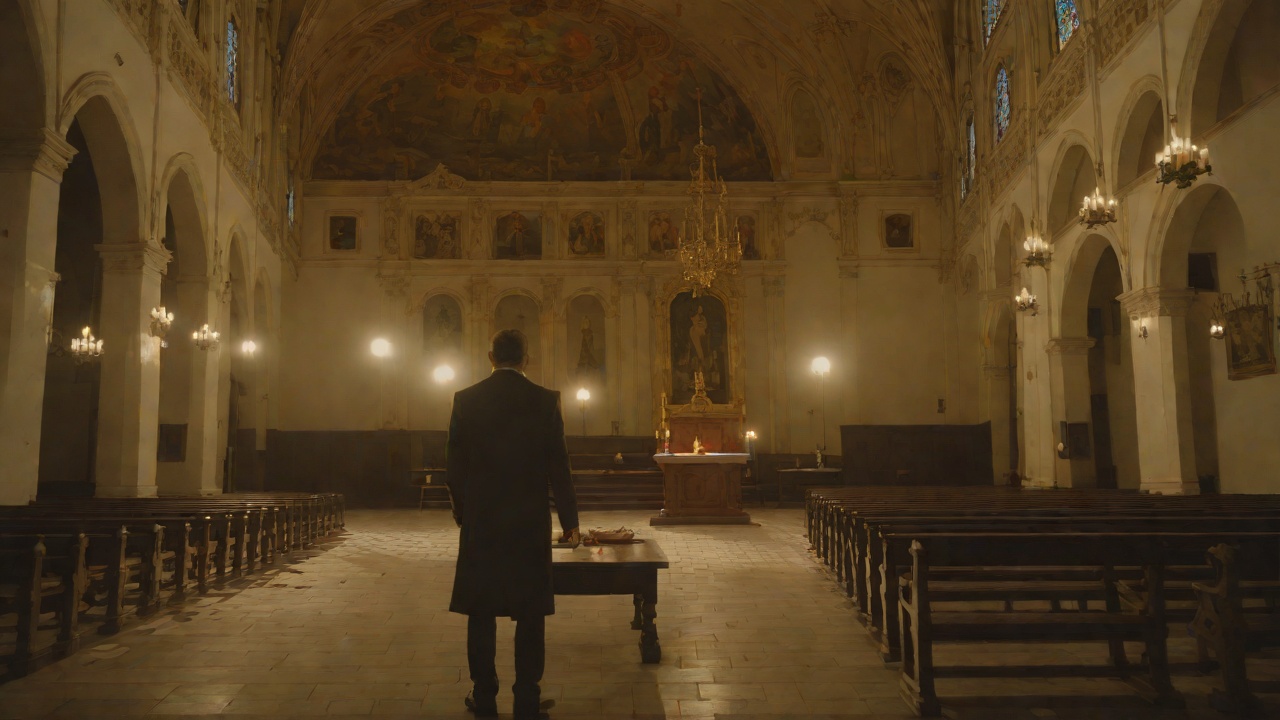
Discovery of the Empty Altar
Context
The rector of St. Timothy's Episcopal Church waits in the balcony with a six-volt searchlight after a string of minor burglaries. He dozes, wakes to a crash from the pantry, and finds the alley door open and a shadow retreating into the night. Behind the altar, where the eight-foot brass cross had stood, there is only the unfaded outline of a crucifix against the paint.
Significance
The police dismiss the cross as scrap metal, worthless to any fence. Yet the empty silhouette gives the theft a strange liturgical quality. What was removed was not economic value but sacred presence, and the absence itself becomes the first text of a theological investigation.
Consequences
Pem begins to walk the city as a self-appointed Divinity Detective, following robes, candlesticks, and kitchen equipment through street markets and secondhand shops. A simple burglary turns into a quest for meaning, and the blank wall behind the altar becomes the negative image of a revelation.
Street Market Traces of the Robbers

Street Market Traces of the Robbers
Context
Pem finds purple choir robes at Astor Place, altar candlesticks in a St. Marks thrift shop, and the church's tea service in a Bowery restaurant-supply district. A peddler in Battery Park wears one of the robes over street clothes, and the laundry mark leads back to Mr. Chung's shop. Each recovered object is bought back by the priest who once used it in worship.
Significance
The trail reveals a homeless and migratory economy of stolen sacred goods. The thieves do not know what they have taken; the goods have been bleached of meaning and reduced to merchandise. Pem's purchases restore the objects but not their original place in the liturgy.
Consequences
The investigation widens from a chase for the cross to a meditation on how the city consumes and discards the remains of faith. Pem begins to suspect that the real thief is not a person but the city's endemic indifference.
The Cross on the Synagogue Roof

The Cross on the Synagogue Roof
Context
Rabbi Joshua Gruen of the Synagogue of Evolutionary Judaism finds the missing brass cross lying flat on his brownstone roof, its upright pressed against the stone pediment. Sarah Blumenthal makes the connection to the newspaper story about St. Timothy's. Pem climbs the iron ladder to the roof and sees the old nicks and dents of his own church cross.
Significance
The cross has crossed from one tradition to another without explanation. For the rabbis it is an execrable symbol burning its brand on their synagogue; for Pem it is both a lost object and a strange gift. The roof becomes a meeting place where Christianity and Judaism confront their shared and divided history.
Consequences
The two clerics become partners in a mystery that neither can solve by conventional detection. The cross is dismantled and carried back to St. Timothy's, but its journey has already changed the meaning of the theft.
Theorizing the Mysterious Transfer

Theorizing the Mysterious Transfer
Context
Pem and Joshua investigate who could have carried the cross across town and hoisted it onto the roof. They rule out the original thieves, then consider anti-Semites, ultra-Orthodox zealots, and random urban nihilists. Each theory collapses under the weight of its own improbability.
Significance
The unsolved transfer brings the two men face to face with the ambiguity of signs. A sign that can be read as hostile can also be read as provocation, or as grace. Their shared detective work becomes a conversation about how God is used and claimed by rival faiths.
Consequences
The mystery is never solved, but the failure of detection opens a deeper inquiry. Pem begins to understand the cross on the synagogue roof not as a crime but as a call to examine the relationship between the two traditions.
A Sign Beyond Human Motive
A Sign Beyond Human Motive
Context
Pem confesses to Everett that he regards the cross's appearance on the synagogue roof as a sign, though he cannot say what it instructs him to do. He keeps this belief private, fearing that speech will drain it of light. The sign remains cryptic, demanding patience and attention rather than explanation.
Significance
The sign belongs to the ancient prophetic mode of apprehension that Pem can no longer rationally justify. Yet it survives his skepticism. It reorients his life away from priestly certainty and toward a humble, dogged act of detection.
Consequences
This private conviction leads him out of the Episcopal priesthood, across Europe in search of a hidden archive, and finally into the Synagogue of Evolutionary Judaism. The stolen cross has become the hinge on which his whole vocation turns.
late on a Monday night, after weeks of small thefts at St. Timothy's
a few days after the theft, during Pem's walks through lower Manhattan
an autumn afternoon after Rabbi Joshua Gruen receives an anonymous phone call
during the weeks after the cross is recovered from the synagogue roof
after the cross is dismantled and hidden behind the altar, before St. Timothy's is deconsecrated
